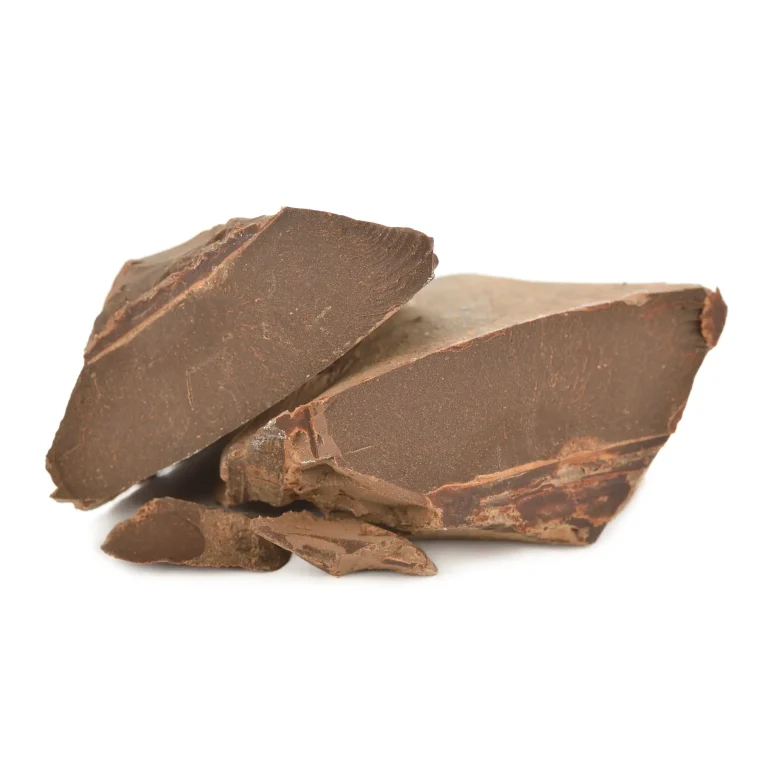

In industrial chocolate production and high-end confectionery manufacturing, few ingredients are as pivotal as pure natural cocoa butter. Representing the native lipid fraction of fermented and roasted cocoa beans, cocoa butter is chemically unique in the plant kingdom due to its narrow triglyceride profile and steep melting curve.
For international procurement directors, research and development (R&D) chemists, and food technologists, understanding the physical chemistry, crystallization polymorphs, and quality grading of cocoa butter is essential to ensuring formulation consistency, long shelf-life, and bloom resistance.
1. Triglyceride Composition and Polymorphic Crystallization
Unlike vegetable shortening or palm kernel oils, which contain diverse and irregular fatty acid distributions, pure cocoa butter is composed predominantly of three symmetrical triacylglycerols (TAGs):
- POP (1,3-dipalmitoyl-2-oleoylglycerol): ~16% – 19%
- POS (1-palmitoyl-2-oleoyl-3-stearoylglycerol): ~36% – 41%
- SOS (1,3-distearoyl-2-oleoylglycerol): ~24% – 31%
This remarkable symmetry gives cocoa butter its distinctive thermal property: it remains hard, snap-firm, and non-greasy at temperatures up to 28°C, but transitions completely and cleanly into a liquid state between 34.0°C and 35.0°C—precisely human body temperature. This produces the pleasant, cooling “melt-in-the-mouth” sensation that defines fine chocolate.
2. The Six Crystal Forms: Mastering Form V Tempering
Cocoa butter can solidify into six distinct polymorphic crystal structures (Forms I through VI). In industrial chocolate tempering, the technical objective is to induce the formation of uniform Form V (β polymorph) crystals:
- Form I (γ): Melts at 17.3°C — very unstable, rapidly transitions.
- Form II (α): Melts at 23.3°C — unstable, fragile.
- Form III (β′): Melts at 25.5°C — soft texture, dull appearance.
- Form IV (β′): Melts at 27.5°C — lacks snap, susceptible to fat bloom.
- Form V (β): Melts at 34.0°C – 35.0°C — The optimal confection state. Delivers brilliant surface gloss, clean acoustic snap, contractive mold release, and superior thermal resistance.
- Form VI (β): Melts at 36.3°C — forms over extended time, resulting in grayish, crystallized fat bloom.
3. Natural vs. Deodorized Cocoa Butter: Which Do You Need?
Depending on target product architecture, global food manufacturers choose between two primary grades:
- Pure Natural (Prime Pressed) Cocoa Butter: Retains its natural, delicate chocolate aroma and golden-yellow hue. Ideal for bean-to-bar chocolate, dark chocolate formulations, and gourmet couverture where authentic cocoa aromatics are prized. Explore our Delico Pure Natural Cocoa Butter specifications.
- Deodorized Cocoa Butter: Steam-treated under high vacuum to strip away volatile aromatic compounds, yielding a neutral flavor profile. Preferred in white chocolate, fruit-flavored confectionery coatings, pharmaceutical suppositories, and premium cosmetic emulsions.
4. Critical Technical Parameters for Bulk Procurement
When reviewing Certificate of Analysis (CoA) documentation from international suppliers, ensure the following parameters meet international Codex Alimentarius standards:
| Parameter | Standard Specification | Significance |
|---|---|---|
| Free Fatty Acid (FFA as oleic) | Max 1.75% | Indicates bean harvest freshness & hydrolytic stability. Low FFA prevents premature rancidity. |
| Slip Melting Point | 34.0°C – 35.0°C | Guarantees full melt in mouth without waxy palate film. |
| Iodine Value (Wijs) | 33 – 42 g I2/100g | Reflects degree of unsaturation and hardness. |
| Saponification Value | 188 – 198 mg KOH/g | Confirms purity and absence of adulterating long-chain or short-chain fats. |
| Moisture & Volatiles | Max 0.20% | Critical for chocolate flow rheology. Water content above 0.3% increases plastic viscosity dramatically. |
5. Global Packaging and Sea Freight Handling
Delico Cocoa packs pure cocoa butter in robust 25 kg multi-ply corrugated cartons with food-grade polyethylene (PE) barrier liners. For containerized sea freight across equatorial and tropical maritime routes, temperature-controlled reefer containers (18°C – 22°C) are strongly recommended to preserve uniform block geometry and eliminate re-crystallization stress.
For custom export volumes, technical data sheets (TDS), or trial sample requests, contact the Delico Cocoa Export Desk today.